
Interpret the ECG
A 78 year old man presents to the emergency department with recurrent dizzy spells and one syncopal episode. He is alert with a regular pulse of 38/min and blood pressure 105/70. His 12-lead ECG is shown.
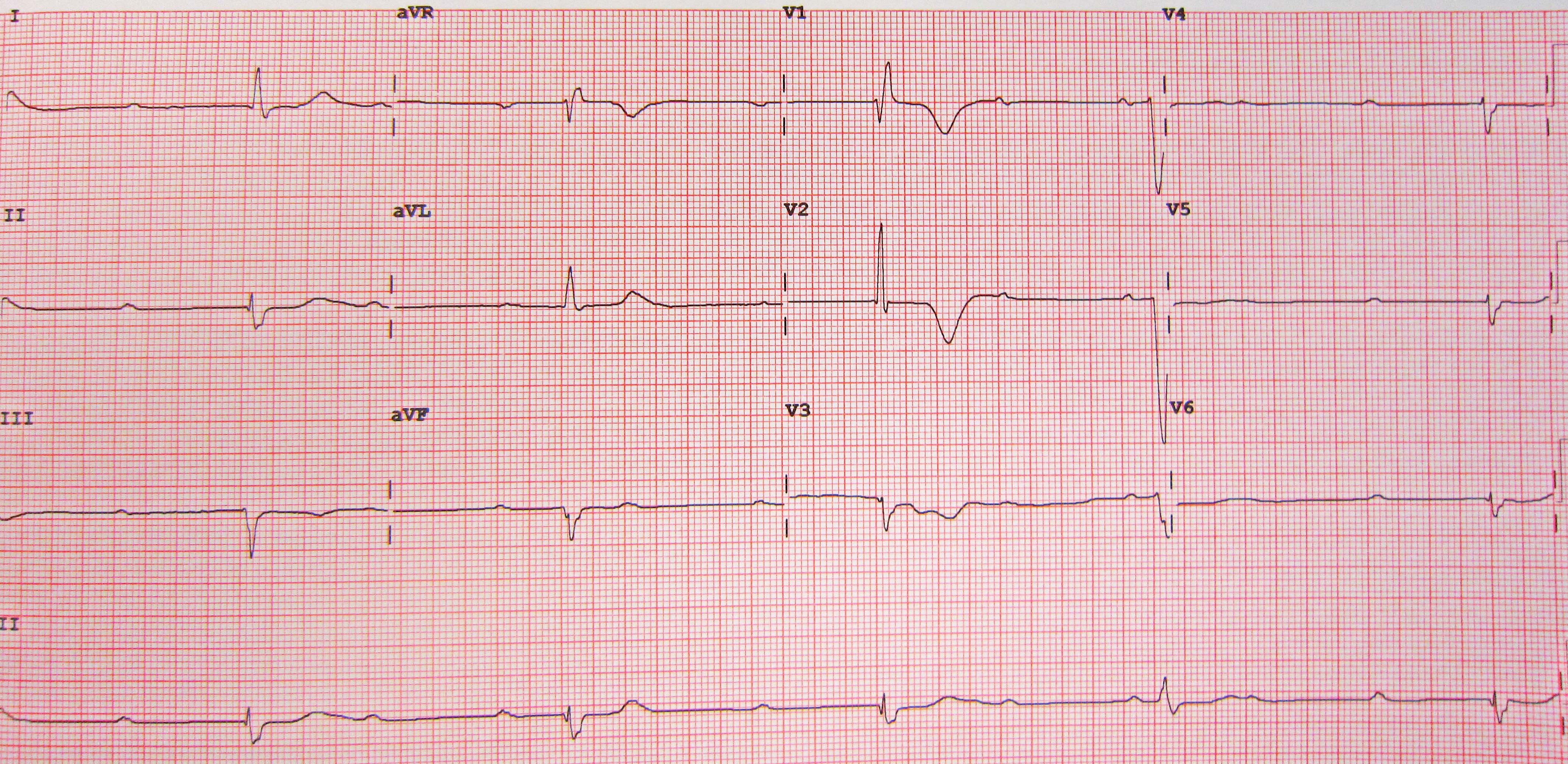
Image could not load. Open the full image or retry before answering.
Clinical reasoning
Regular P waves marching through at a faster rate, entirely dissociated from a slower regular ventricular escape rhythm, define complete (third-degree) AV block; the fixed slow ventricular rate with no consistent PR relationship and syncope (Stokes-Adams) is the classic presentation.
Review the other options
A. In 2:1 block alternate P waves conduct with a fixed PR, giving exactly two P waves per conducted QRS; this trace shows P waves that bear no fixed relationship to the QRS at all (variable PR).
C. Wenckebach shows progressive PR lengthening then a single dropped QRS, and conducted beats retain a fixed P-QRS relationship, unlike the total AV dissociation seen here.
D. First-degree block keeps every P wave conducting with a constant prolonged PR; there is no AV dissociation, and each QRS is preceded by its own P at a fixed interval.
E. AF has no organised P waves and an irregularly irregular ventricular response; here discrete regular P waves and a regular ventricular rate are present.
.jpg)